Optimize Your Calorie Needs with Precision Testing
At Biohackr Health, we believe understanding your body’s baseline calorie utilization is fundamental to achieve sustainable weight management, performance goals, and long-term health. Resting Metabolic Rate (RMR) testing is the gold standard for measuring how many calories your body burns at rest and how that number changes over time.
Serving patients in San Francisco, Palo Alto, and throughout the Bay Area, Biohackr Health offers medical team supervised RMR testing as part of a comprehensive, data-driven approach to metabolic optimization, often integrated with medical weight loss programs and hormone optimization therapies for men and women. Whether you are navigating weight loss, experiencing a plateau, or focused on longevity, RMR testing provides actionable insight into how your body is actually functioning, not how it is estimated to function.
At Biohackr Health, RMR testing is performed using our CardioCoachPro metabolic analysis system in our Palo Alto clinic, with San Francisco coming soon. This allows for highly individualized measurement of your baseline metabolism, giving you a more precise foundation for nutrition, training, and hormone optimization strategies.
- What Is Resting Metabolic Rate?
- Why RMR Testing Matters for Your Health
- The Benefits of RMR Testing
- What Affects Your Resting Metabolic Rate?
- Can You Change Your RMR?
- How We Measure RMR: Indirect Calorimetry
- What to Expect During Your RMR Test
- How to Prepare for Your RMR Test
- Who Benefits from RMR Testing?
- RMR Testing at Biohackr Health
- Why Choose Biohackr Health for RMR Testing
- Frequently Asked Questions
What Is Resting Metabolic Rate?
Resting Metabolic Rate measures how much energy your body uses to maintain essential functions while at rest,12 including breathing, circulation, brain activity, and cellular repair.
For most adults, RMR accounts for approximately 60–75% of total daily energy expenditure.1,2 It typically falls within a broad range (often between approximately 1,000 and 2,000 calories per day) depending on body composition, sex, and metabolic health. Men generally have higher baseline energy needs due to greater lean muscle mass.
Compared to basal metabolic rate (BMR), which is measured under highly controlled conditions, RMR is assessed in a more practical clinical setting and is typically about 5–10% higher, making it more useful for real-world planning.3

Why RMR Testing Matters for Your Health
RMR is one of the most important—and most misunderstood—metrics in metabolism.
Understanding your RMR allows for:
- Accurate calorie targets for weight loss, maintenance, or muscle gain
- Identification of metabolic slowdown during dieting
- More precise nutrition planning
- Improved athletic performance strategies, including integration with VO₂ max testing
- Insight into metabolic health and aging
Many individuals struggling with weight loss are unknowingly under-eating, which can lower RMR and stall progress. This is a well-documented metabolic response known as adaptive thermogenesis.4
RMR is also used clinically to guide nutrition therapy and treatment planning for metabolic and endocrine conditions, helping providers tailor interventions based on measurable physiology rather than estimates.5
Not sure if your metabolism is helping or holding you back? RMR testing provides a clear starting point for building a plan that actually works.
The Benefits of RMR Testing
RMR testing provides objective data that removes guesswork from your health strategy.
It can help you:
- Understand your true baseline metabolism
- Identify why weight loss has plateaued
- Adjust calorie intake based on real physiology, not estimates
- Track metabolic changes during diet, exercise, or hormone therapy
- Monitor how interventions like strength training, NAD+ therapy, or nutrition changes are working
At Biohackr Health, this data is interpreted within the context of your broader health plan, not in isolation.
What Affects Your Resting Metabolic Rate?
RMR is influenced by multiple physiologic and lifestyle factors:
Lean Muscle Mass
Lean body mass is the strongest predictor of metabolic rate. Muscle requires more energy to maintain than fat, meaning higher muscle mass increases RMR.6,7
Organ Function
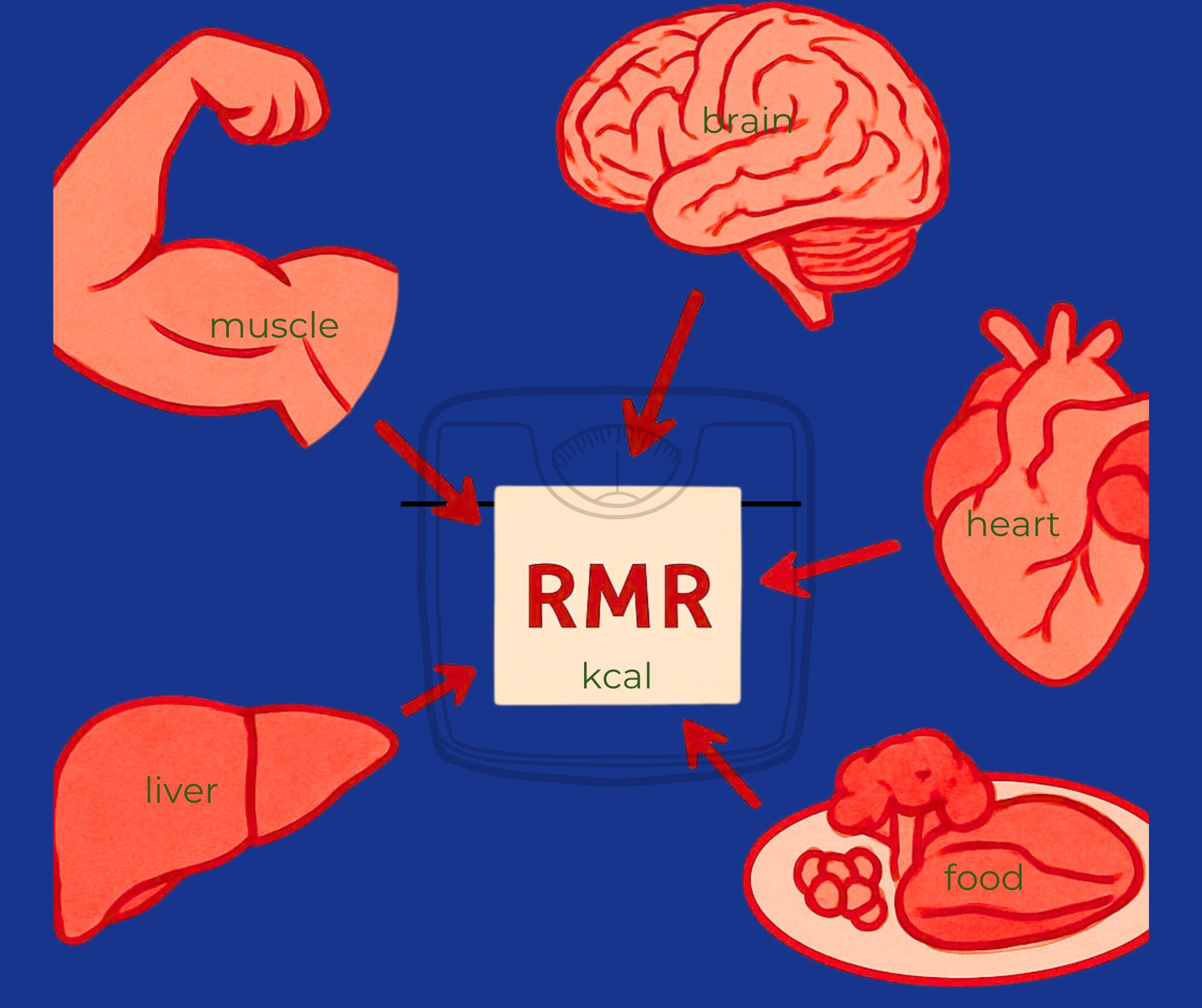
High-energy organs such as the brain, liver, heart, and kidneys contribute significantly to metabolic activity, accounting for a large portion of resting energy expenditure.8 Notably, the brain and liver together represent only about 2% of body weight but account for roughly 20% of total RMR. Although these organs make up a relatively small percentage of total body weight, they are responsible for a disproportionately large share of metabolic demand.
Calorie Intake
Severe calorie restriction can reduce RMR by approximately 7–10%, contributing to stalled weight loss and metabolic adaptation.9 In contrast, increased energy intake can raise RMR, which is one reason metabolic rate is considered a responsive, changing metric rather than a fixed number.
Exercise
Exercise influences metabolism in complex ways. Resistance training may help preserve metabolic rate through muscle maintenance, while overall impact depends on both energy intake and training intensity.10 Exercise may also help offset some of the decline in RMR seen with caloric restriction, particularly when frequency, intensity, and duration are sufficient. It’s worth noting that exercise-related changes in RMR tend to be more acute than chronic: when training stops, metabolic gains can diminish, which is why consistency matters.
Hormonal Balance
Hormones (including thyroid, cortisol, estrogen, and testosterone) play a significant role in metabolic regulation. These factors are often evaluated through hormone optimization therapies for men and women.
Age
RMR declines with age, in part due to reductions in muscle mass and shifts in hormonal balance. Research suggests baseline metabolic rate decreases by roughly 62 kcal per day each decade, a gradual shift that often contributes to unexplained weight gain in midlife and menopause.
Additional Factors
- Sex
- Body composition
- Environmental conditions
- Genetics
These factors are measurable and modifiable.
Understanding which ones are affecting you is the first step toward changing them.
Can You Change Your RMR?
Yes, though it’s important to understand that a significant portion of your RMR is relatively fixed by factors like organ function, sex, and body size. The most impactful lever you can actually control is lean muscle mass, which is why it’s the primary focus at Biohackr Health.
At Biohackr Health, strategies may include:
- Increasing lean muscle mass through resistance training and supportive strategies such as creatine when appropriate
- High-intensity interval training (HIIT) and consistent aerobic activity
- Avoiding prolonged caloric restriction
- Optimizing hormone levels through personalized hormone therapy
- Supporting mitochondrial efficiency and ATP production through NAD+ therapy and creatine
Because metabolism adapts, repeat testing every 3–4 months is often recommended during active programs.11
This is where testing becomes actionable. Without measuring your metabolism, it’s difficult to know whether your strategy is helping or slowing you down.

How We Measure RMR: Indirect Calorimetry
At Biohackr Health, RMR is measured using indirect calorimetry, the clinical gold standard.
This method evaluates:
- Oxygen consumption
- Carbon dioxide production
- Respiratory exchange ratio (RER)
These measurements provide a highly accurate calculation of energy expenditure at rest.12
Compared to predictive equations, indirect calorimetry offers individualized data and significantly reduces variability in calorie estimation.13,14
RMR vs. Predictive Equations
Many online calculators estimate calorie needs using formulas such as the Mifflin-St Jeor equation.
While these models are useful, they are typically accurate within about 10% and individual variation can be significant.15
For patients actively managing weight or performance, direct measurement provides a more precise foundation.
What to Expect During Your RMR Test
RMR testing is simple, non-invasive, and takes approximately 20–30 minutes.
During your test:
- You will be reclining comfortably (not lying flat)
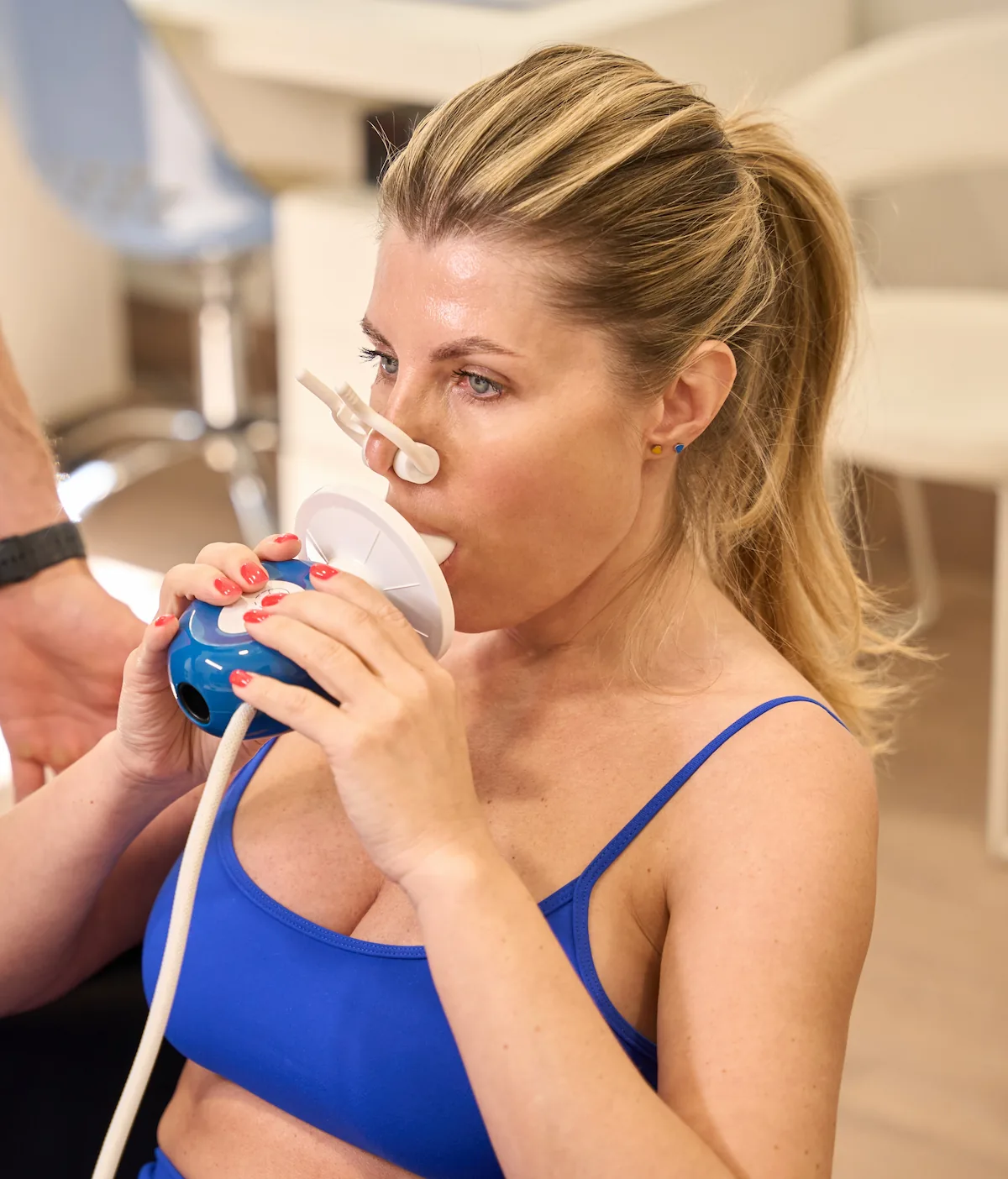
- A nose clip and mouthpiece will be fitted to measure your breathing
- You will breathe normally while measurements are collected
- Data collection typically takes around 10 minutes, within a 20–30 minute appointment
- Talking or movement is minimized to maintain accuracy16
Before the test begins, you will have a few minutes to settle in and acclimate to the breathing setup. To keep the measurement as accurate as possible, you should remain relaxed, avoid talking, and stay off your phone or other distractions during the test.
How to Prepare for Your RMR Test
Because preparation has a direct effect on measurement accuracy, RMR testing should be scheduled intentionally rather than done casually or without advance planning.
Before your test:
- Fast for at least 4 hours (overnight preferred)
- Avoid exercise for 12 hours
- Avoid caffeine or stimulants
- Stay hydrated
- Take medications consistently
Consistency is critical, especially for tracking progress over time.17 RMR prep blog
RMR Testing at Biohackr Health
We currently offer RMR testing in our Palo Alto clinic, with San Francisco coming soon.
Testing is often integrated with:
- VO₂ max testing
- InBody Scan: paired with RMR, this gives you a complete picture of body composition (body fat and muscle composition) and metabolic demand, helping identify exactly where muscle mass can be built to raise your baseline
- Hormone optimization
- NAD+ therapy
- Creatine
This allows for a comprehensive, personalized approach to metabolic health. For patients actively working through fitness, hormone, or medical weight loss programs, repeat RMR testing can help show whether interventions are meaningfully changing baseline calorie needs over time.
Who Benefits from RMR Testing?
RMR testing is valuable for:
- Individuals pursuing weight loss, weight gain, or body recomposition
- Patients experiencing stalled progress or metabolic plateaus
- Athletes optimizing fueling and training strategies
- Adults navigating midlife and menopause-related metabolic changes
- Patients participating in medical weight loss or hormone optimization programs
- Underweight patients or those recovering from prolonged caloric restriction, who may become hypermetabolic and require significantly higher calorie intake, sometimes more than 4,000 calories per day, to safely restore healthy weight

Why Choose Biohackr Health for RMR Testing
- Medical team supervised metabolic testing
- Gold-standard indirect calorimetry
- Data-driven, individualized recommendations
- Integration with weight loss and hormone programs
- Focus on long-term metabolic health and longevity
- Led by board-certified physicians with decades of experience in regenerative medicine, hormone optimization, and anti-aging care
“Hormone therapy should be a dialogue — not a prescription handed out without context.” —
Dr. Lori Bluvas
Frequently Asked Questions
How often should I test my RMR?
Every 3–4 months (roughly 12 weeks) is typical during active weight loss, fitness, or hormone programs. Patients focused on general health optimization may test 2–3 times per year.18
Can RMR testing help with weight loss?
Yes. It provides accurate calorie targets and identifies metabolic adaptations that may be limiting progress.
Is RMR testing safe?
Yes. It is non-invasive and does not require physical exertion.19
Can I improve my metabolism?
Yes, though within limits. A meaningful portion of RMR is fixed by factors outside your control (organ function, sex, body size). The most modifiable lever is lean muscle mass. Strategies include resistance training, HIIT, aerobic activity, supporting mitochondrial function (through NAD+ and creatine), and optimizing hormone levels.
Does RMR testing tell me exactly how many calories I should eat?
RMR provides your baseline calorie burn at rest. Your total daily calorie needs are then adjusted based on activity level, goals, and metabolic factors, which your provider will help interpret.
Where can I find RMR testing near me?
Biohackr Health offers RMR testing in Palo Alto, with San Francisco coming soon. Our team serves patients throughout the Bay Area.
Take the Guesswork Out of Your Metabolism
If your progress has stalled or you’re tired of guessing your calorie needs, RMR testing provides gold standard indirect calorimetry of your individual actual caloric needs, giving you a clear, measurable path forward.
Many patients pair RMR testing with structured weight loss, fitness, or hormone optimization programs to create a more precise, personalized strategy. VO2 max is also great, as it gives objective data on when you transition from burning fat to utilizing carbohydrates. We feel passionately about both tests for our patients.
Schedule your RMR test at Biohackr Health and build a strategy grounded in real data—not estimates.
Sources
1 McMurray RG, Soares J, Caspersen CJ, McCurdy T. Examining variations of resting metabolic rate of adults: a public health perspective. Med Sci Sports Exerc. 2014 Jul;46(7):1352-8. doi: 10.1249/MSS.0000000000000232. PMID: 24300125; PMCID: PMC4535334. Available: https://pubmed.ncbi.nlm.nih.gov/24300125/. Accessed April 15, 2026.
2 De Lorenzo A, Tagliabue A, Andreoli A, Testolin G, Comelli M, Deurenberg P. Measured and predicted resting metabolic rate in Italian males and females, aged 18-59 y. Eur J Clin Nutr. 2001 Mar;55(3):208-14. doi: 10.1038/sj.ejcn.1601149. PMID: 11305270. Available: https://pubmed.ncbi.nlm.nih.gov/11305270/. Accessed April 15, 2026.
3 Owen OE. Resting metabolic requirements of men and women. Mayo Clin Proc. 1988 May;63(5):503-10. doi: 10.1016/s0025-6196(12)65649-3. PMID: 3361959. Available: https://pubmed.ncbi.nlm.nih.gov/3361959/. Accessed April 15, 2026.
4 Molé PA. Impact of energy intake and exercise on resting metabolic rate. Sports Med. 1990 Aug;10(2):72-87. doi: 10.2165/00007256-199010020-00002. PMID: 2204100. Available: https://pubmed.ncbi.nlm.nih.gov/2204100/. Accessed April 15, 2026.
5 Lesser MNR, Lesser LI. Nutrition Support Therapy. Am Fam Physician. 2021 Dec 1;104(6):580-588. PMID: 34913658. Available: https://pubmed.ncbi.nlm.nih.gov/34913658/. Accessed April 15, 2026.
6 McMurray RG, Soares J, Caspersen CJ, McCurdy T. Examining variations of resting metabolic rate of adults: a public health perspective. Med Sci Sports Exerc. 2014 Jul;46(7):1352-8. doi: 10.1249/MSS.0000000000000232. PMID: 24300125; PMCID: PMC4535334. Available: https://pubmed.ncbi.nlm.nih.gov/24300125/. Accessed April 15, 2026.
7 Cunningham JJ. A reanalysis of the factors influencing basal metabolic rate in normal adults. Am J Clin Nutr. 1980 Nov;33(11):2372-4. doi: 10.1093/ajcn/33.11.2372. PMID: 7435418. Available: https://pubmed.ncbi.nlm.nih.gov/7435418/. Accessed April 15, 2026.
8 Javed F, He Q, Davidson LE, Thornton JC, Albu J, Boxt L, Krasnow N, Elia M, Kang P, Heshka S, Gallagher D. Brain and high metabolic rate organ mass: contributions to resting energy expenditure beyond fat-free mass. Am J Clin Nutr. 2010 Apr;91(4):907-12. doi: 10.3945/ajcn.2009.28512. Epub 2010 Feb 17. PMID: 20164308; PMCID: PMC2844678. Available: https://pubmed.ncbi.nlm.nih.gov/20164308/. Accessed April 15, 2026.
9 Molé PA. Impact of energy intake and exercise on resting metabolic rate. Sports Med. 1990 Aug;10(2):72-87. doi: 10.2165/00007256-199010020-00002. PMID: 2204100. Available: https://pubmed.ncbi.nlm.nih.gov/2204100/. Accessed April 15, 2026.
10 Bullough RC, Gillette CA, Harris MA, Melby CL. Interaction of acute changes in exercise energy expenditure and energy intake on resting metabolic rate. Am J Clin Nutr. 1995 Mar;61(3):473-81. doi: 10.1093/ajcn/61.3.473. PMID: 7872209. Available: https://pubmed.ncbi.nlm.nih.gov/7872209/. Accessed April 15, 2026.
11 Molé PA. Impact of energy intake and exercise on resting metabolic rate. Sports Med. 1990 Aug;10(2):72-87. doi: 10.2165/00007256-199010020-00002. PMID: 2204100. Available: https://pubmed.ncbi.nlm.nih.gov/2204100/. Accessed April 15, 2026.
12 Owen OE. Resting metabolic requirements of men and women. Mayo Clin Proc. 1988 May;63(5):503-10. doi: 10.1016/s0025-6196(12)65649-3. PMID: 3361959. Available: https://pubmed.ncbi.nlm.nih.gov/3361959/. Accessed April 15, 2026.
13 Owen OE. Resting metabolic requirements of men and women. Mayo Clin Proc. 1988 May;63(5):503-10. doi: 10.1016/s0025-6196(12)65649-3. PMID: 3361959. Available: https://pubmed.ncbi.nlm.nih.gov/3361959/. Accessed April 15, 2026.
14 De Lorenzo A, Tagliabue A, Andreoli A, Testolin G, Comelli M, Deurenberg P. Measured and predicted resting metabolic rate in Italian males and females, aged 18-59 y. Eur J Clin Nutr. 2001 Mar;55(3):208-14. doi: 10.1038/sj.ejcn.1601149. PMID: 11305270. Available: https://pubmed.ncbi.nlm.nih.gov/11305270/. Accessed April 15, 2026.
15Gonzalez-Campoy JM, St Jeor ST, Castorino K, et al. Clinical practice guidelines for healthy eating for the prevention and treatment of metabolic and endocrine diseases in adults: cosponsored by the American Association of Clinical Endocrinologists, the American College of Endocrinology, and the Obesity Society. Endocr Pract. 2013;19(Suppl 3):1-82. doi:10.4158/EP13155.GL. Available: https://www.endocrinepractice.org/article/S1530-891X(20)43460-3/fulltext. Accessed April 15, 2026.
16 Owen OE. Resting metabolic requirements of men and women. Mayo Clin Proc. 1988 May;63(5):503-10. doi: 10.1016/s0025-6196(12)65649-3. PMID: 3361959. Available: https://pubmed.ncbi.nlm.nih.gov/3361959/. Accessed April 15, 2026.
17 De Lorenzo A, Tagliabue A, Andreoli A, Testolin G, Comelli M, Deurenberg P. Measured and predicted resting metabolic rate in Italian males and females, aged 18-59 y. Eur J Clin Nutr. 2001 Mar;55(3):208-14. doi: 10.1038/sj.ejcn.1601149. PMID: 11305270. Available: https://pubmed.ncbi.nlm.nih.gov/11305270/. Accessed April 15, 2026.
18 Molé PA. Impact of energy intake and exercise on resting metabolic rate. Sports Med. 1990 Aug;10(2):72-87. doi: 10.2165/00007256-199010020-00002. PMID: 2204100. Available: https://pubmed.ncbi.nlm.nih.gov/2204100/. Accessed April 15, 2026.
19 Owen OE. Resting metabolic requirements of men and women. Mayo Clin Proc. 1988 May;63(5):503-10. doi: 10.1016/s0025-6196(12)65649-3. PMID: 3361959. Available: https://pubmed.ncbi.nlm.nih.gov/3361959/. Accessed April 15, 2026.