
I just saw another celebrity did blood filtration. Joe Rogan was interviewed in Men’s Health about doing blood filtration. He is quoted as saying, “This is the stuff they pulled out of my blood,” Rogan wrote in his Instagram caption. He also notes that plasma “carries a lot of the inflammatory proteins, toxins, and byproducts that build up over time.” One of the things the article discussed was the removal of microplastics.
What are microplastics?
Microplastics and nanoplastics are small plastic particles which come from everywhere- cosmetics, medical drugs, plastic containers, plastic packaging, your plastic cutting board. It is only recently that we are starting to understand the health issue of these. Microplastics are 1 μm–5 mm, and nanoplastics are <1 μm. These have been hard to study due to their small size and the fact that any “sample” we try to analyze gets contaminated instantly.
Microplastics have been found in tissue- lung, heart, liver, brain, and gut. It is thought that it may be causing diseases, like fertility issues, cancer, and maybe even dementia. Some postulate it may be leading to stress and cortisol issues.
Does blood filtration remove microplastics?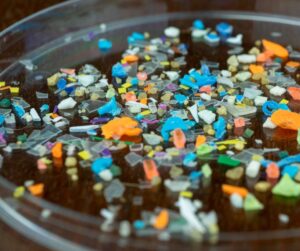
The answer is maybe. There is a study, which I will discuss below, of 21 patients which claims it may remove microplastics. But the study is not super clear. What size particles did it remove? They did not test the amount removed. How thorough is it? Do multiple passes clear it more? How clean is the blood after? And what about the microplastics embedded in our tissue? Does it release after the blood is cleared? What is our ongoing threat?
Study “Therapeutic apheresis: A promising method to remove microplastics?”
This was a study published in June 2025 in Brain Medicine. It was a small study, and they are the first to admit that it is hard to make great conclusions due to issues of potential contamination and the small sample size.
- 21 patients with brain issues
- Two cycles of “therapeutic apheresis with double filtration.”
- The fluid removed was analyzed for microplastics
- Findings? 14 different substances were found which looked like polyamide 6 (nylon).
They discussed the issues of the study: They did not quantitate the amount found. It only detects if they are present. They conclude, “In this study, we demonstrate for the first time that extracorporeal therapeutic apheresis might have this capability. However, larger patient cohorts and quantitative analyses, such as pyrolysis gas chromatography mass spectrometry, are required to confirm the effective removal of MNPs through therapeutic apheresis. This should include measuring MNP levels in plasma samples before and after apheresis, as well as in eluates, across multiple cycles.”
Biohackr Health and EBOO
We think there is something *there* with blood filtration. We love that this study showed there was some removal of particles, but in their conclusion, they state further studies need to show levels of microplastics in the blood before and after filtration, the amounts measured, and how it changes after multiple cycles.
But given that EBO2 is well tolerated, the “downside’ seems to be low. We have patients with inflammation, autoimmune issues, Lyme, and other difficult to treat issues who have felt better after blood filtration. There was a recent study which indicates filtration may help remove the proteins associated with Alzheimers. At Biohackr Health clinics in Palo Alto and San Francsico, our system of EBOO combines blood filtration WITH oxygenation and ozonation, so it is giving more treatment. We think EBO2 is in the “promising but not proven” section of biohacking.
To see more in depth on EBOO at Biohackr Health, see our page on EBOO. To keep up to date on emerging studies, read our EBO2 blogs.
References:
Men’s Health article, “Joe Rogan is taking what out of his body? ” LINK
Therapeutic apheresis: A promising method to remove microplastics?, June 2025 LINK